Dubai Customs' AI Strategy 2030 Drives a New Generation of Customs Services
Smart Technology, Measurable Value: “Al Munasiq 2.0” Delivers About AED 21 Million in Savings for Customers
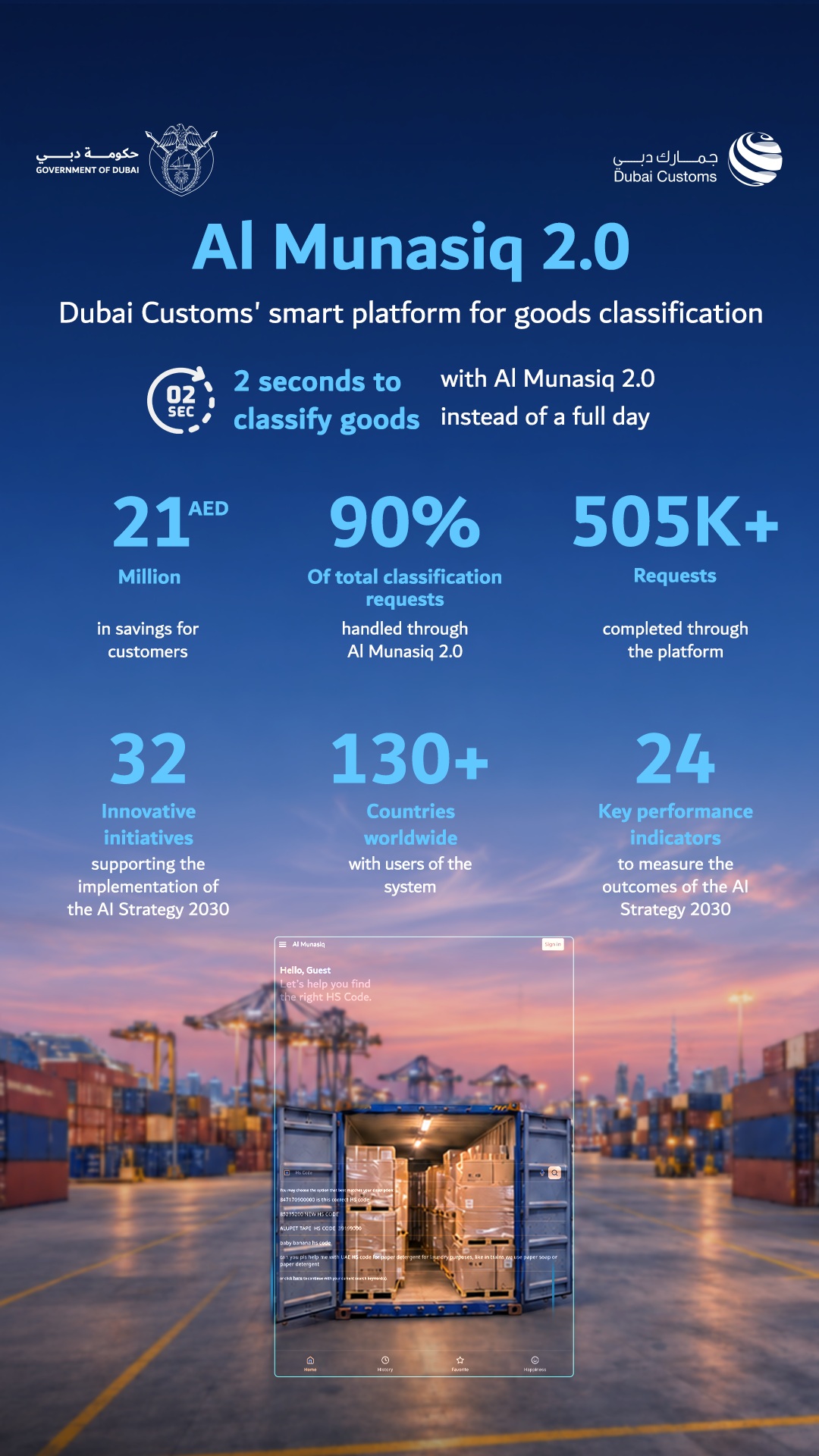
• Easing the way of doing business: goods classification time cut from a full day to two seconds
• More than 505,000 requests submitted through "Al Munasiq 2.0," representing 90% of all classification requests
• Users in more than 130 countries reflect the global reach of customs innovation in Dubai
• 32 initiatives and 24 key indicators drive implementation of the AI Strategy 2030
At Dubai Customs, artificial intelligence has moved well beyond improving services. It now anchors a strategic shift in how customs work is done, one that sharpens Dubai’s competitive edge and strengthens its pull on global trade and investment. By putting advanced technologies to work, the department is delivering services that are faster, more accurate, and more efficient, and turning data into smart decisions with lasting economic impact. This is the thinking behind Dubai Customs’ AI Strategy 2030, a roadmap to a new generation of customs operations and services driven by data, artificial intelligence, and proactive prediction.
"Al Munasiq 2.0" is one of the most prominent practical applications of this strategy. It has transformed the goods classification inquiry service, one of the specialized customs services, into a smart, instant, AI-powered experience, delivering savings of about AED 21 million for customers between January 1, 2024, and August 9, 2026.
These results coincide with UAE Innovates, the Emirates innovation month, whose events Dubai Customs is organizing under the slogan "Customs of ideas. Dubai-it." The organization offers a living model of innovation that turns ambitious ideas and advanced technologies into high-quality achievements with tangible economic impact. The results achieved by "Al Munasiq 2.0" reflect Dubai Customs' success in moving innovation beyond developing solutions to creating added value for customers and business sectors, by saving time, cutting costs, and raising the efficiency of customs services. These achievements also embody the vision of the UAE and Dubai to make innovation a driving force for economic growth and global competitiveness. They underscore Dubai Customs' role in anticipating the future of trade and developing smart solutions that go beyond traditional notions of customs work, supporting the smooth flow of trade, reinforcing Dubai's appeal for high-quality investment, contributing to the goals of the Dubai Economic Agenda (D33), and cementing the emirate's position as a leading global hub for trade and for an economy built on knowledge and advanced technology.
The data showed that total goods classification requests during the same period reached about 558.8 thousand, of which "Al Munasiq 2.0" handled more than 505,000, or 90% of all requests, compared with 53.8 thousand through the previous classification channels. The application also recorded 16 thousand downloads and reached users in more than 130 countries. This shows that the innovation developed by Dubai Customs extends well beyond its local scope, and strengthens Dubai's global standing in government innovation and digital customs services.
"Al Munasiq 2.0" is distinguished by its ability to cut goods classification time from a full day to just two seconds. Drawing on AI and big data analytics, it instantly and accurately identifies a product's Harmonized System code, provides its description, and determines the customs duties payable on it, as well as whether it is prohibited or restricted.
This helps reduce classification errors, raise the efficiency of procedures, improve the quality of customs data, and give companies greater clarity and certainty before they complete their transactions.
The platform's economic impact extends to easing the operational burden on companies, lowering compliance costs, and reducing the rework caused by classification errors. This allows companies to direct more of their resources toward expansion and growth, supports supply chain efficiency, and strengthens the competitiveness of Dubai's business environment, which is built on speed, transparency, and certainty.
Juma Al Ghaith, Advisor to the Director General and Executive Director of Artificial Intelligence at Dubai Customs, said the results achieved by "Al Munasiq 2.0" confirm that the true value of artificial intelligence is measured not only by the speed of a service, but by the scale of its impact on operational efficiency, customers, and the economy. He noted that Dubai Customs takes an approach based on applying advanced technologies to develop the customs business model in an integrated way, rather than merely digitizing existing procedures.
He added that "Al Munasiq 2.0" is one of the key outcomes of Dubai Customs' AI Strategy 2030, which aims to expand the use of AI across all areas of customs work, support decision-making, raise productivity, improve resource utilization, and strengthen operational readiness to keep pace with rapid shifts in global trade and logistics.
For his part, Atiq Al Muhairi, Executive Director of the Customs Development Division at Dubai Customs, affirmed that digital transformation and the use of AI are a central axis in developing customs operations and services, through redesigning procedures, simplifying the customer journey, and speeding up the completion of transactions. This enhances ease of doing business, raises performance efficiency, and keeps pace with the rapid growth in trade traffic and the evolving needs of the business community.
Al Muhairi said: "We are using artificial intelligence as a practical tool to develop services and re-engineer customs operations, so that advanced technologies translate directly into faster completion, more accurate procedures, and a better customer experience. 'Al Munasiq 2.0' is a clear example of this approach: it has taken goods classification from a procedure that demands time and effort to a smart, instant service that gives companies the information they need to make decisions and complete their transactions more efficiently."
He added: "We continue to develop our digital operations and to link innovation to the needs of business sectors, helping to reduce operational burdens, strengthen the smooth flow of trade, and support Dubai's competitiveness and its appeal as a global hub for business and trade."
Dubai Customs' AI Strategy 2030 is built on developing advanced digital capabilities that support the new generation of customs operations. It promotes the use of AI in risk assessment, forecasting changes, and supporting strategic decision-making, alongside developing smart service channels, improving resource allocation, and embedding a culture of innovation and continuous learning, thereby ensuring sustainable development and higher performance efficiency across the department.
The strategy covers six main areas: the AI smart foundation, AI-enabled channels, predictive risk assessment, smart risk handling, smart inspection, and smart post-clearance audit. It is supported by 32 innovative initiatives, and its outcomes are measured through 24 key performance indicators, ensuring continuous tracking of impact and higher levels of efficiency and readiness.
The strategy also comprises several pillars: "An Exceptional Customer Experience," through AI-powered solutions that deliver seamless, effective services across all service delivery channels and programs; "AI-Enhanced Digital Capabilities," building a digital infrastructure and advanced AI capabilities to support next-generation customs operations and improve decision-making; "Decision-Making and Risk Management Enablement," leveraging AI to strengthen risk assessment, future forecasting, and strategic decision-making capabilities, raising operational performance efficiency; "Optimized Resource Allocation," applying AI-powered smart resource management systems to maximize operational efficiency and economic viability across all customs departments; and "Embedding a Culture of AI Innovation," by providing an environment that encourages innovation and continuous learning and adopts the latest AI technologies across the entire department.