From Simulation to Service: 33 Inspectors Graduate from Dubai Customs’ “Masar 33”
Fourth and Fifth Batches of the Advanced Security Refresher Course Graduate in Cooperation with Dubai Police Academy
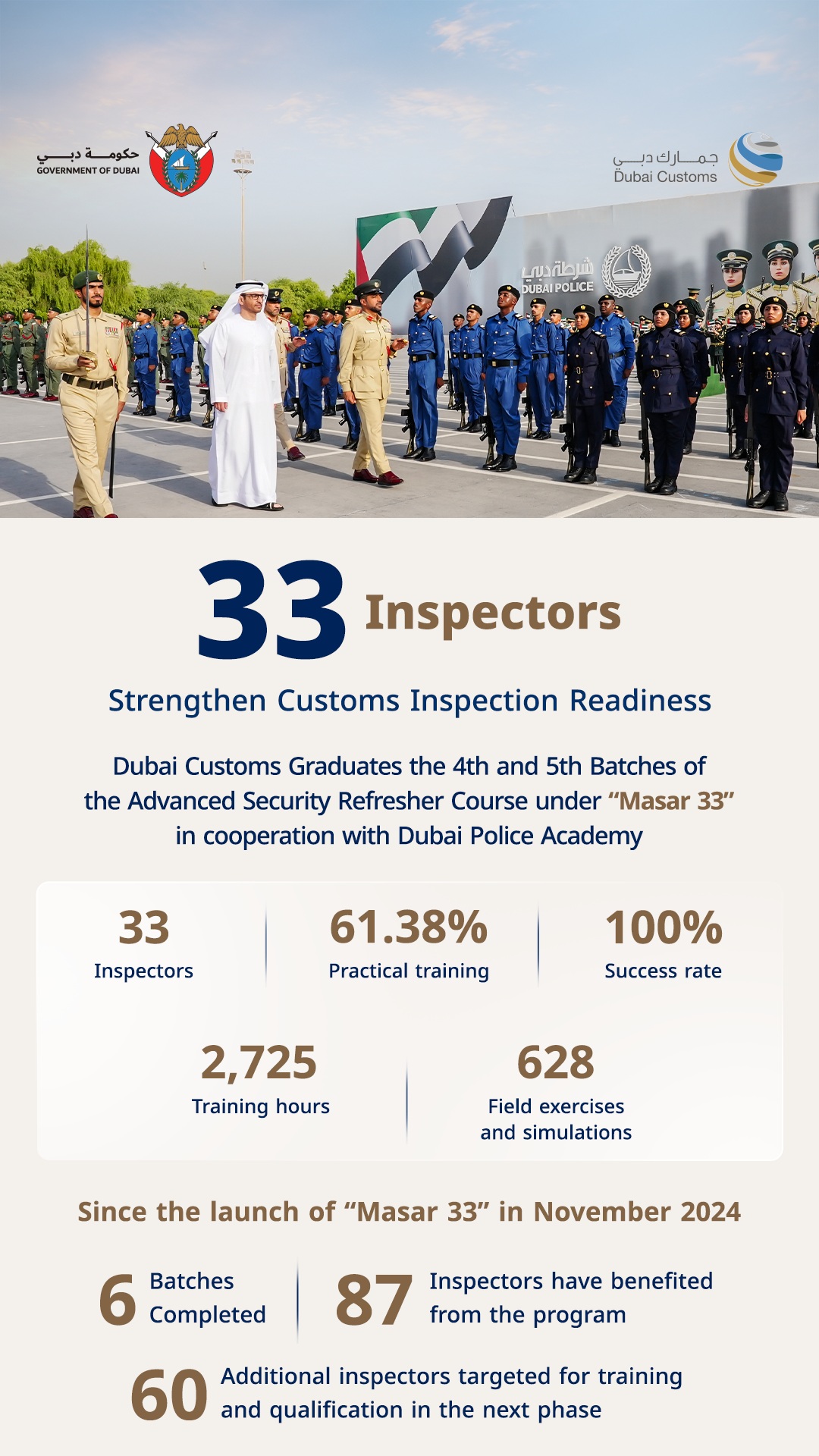
Dubai Customs has strengthened the readiness of its customs workforce by graduating 33 inspectors from the fourth and fifth batches of the Advanced Security Refresher Course under “Masar 33,” following the completion of an intensive training program that combined specialized qualification, practical application, and field training. The program aims to develop inspectors’ capabilities and raise their proficiency in handling the various cases and risks associated with customs inspection duties. It is part of Dubai Customs’ broader efforts to prepare qualified national talent that combines specialized knowledge with field skills, and to strengthen their readiness to carry out customs inspection duties efficiently—supporting the system that protects society and the national economy, and reinforcing the efficiency of customs work in the Emirate of Dubai.
.jpg)
The program totaled 2,725 training hours, comprising theoretical and practical training, field exercises, and simulations, with the practical component accounting for approximately 61.38 percent of the total. It also included 628 field exercises and simulations of scenarios related to the nature of customs work, achieving a 100 percent success rate—reflecting the program’s emphasis on practical application and on measuring participants’ readiness to meet real job requirements.
.jpg)
The graduation of the fourth and fifth batches took place during a ceremony held on August 28, 2026, at Dubai Police Academy. Attendees included Brigadier Abdulaziz Mohammed Amin Al Abdullah, patron of the ceremony; Colonel Yousef Ahmed Al Blooshi, Director of the Training Institute at Dubai Police Academy; Mohammed Al Ghaffari, Executive Director of the Customs Inspection Division at Dubai Customs; directors of customs center departments; and a number of officials and stakeholders. The two batches comprised 33 inspectors—all new employees—including 24 male inspectors and 9 female inspectors.
In addition to military and physical training, the course covered a range of specialized modules directly related to the duties of a customs inspector, including strengthening security awareness, combating narcotics, body language, the basics of hazardous materials classification, and occupational health and safety, alongside skills in inspecting persons, luggage, vehicles, ships, parcels, and containers, as well as inspecting gold and jewelry and identifying smuggling and customs evasion methods. The course’s advanced nature is built on linking specialized knowledge to field realities through simulations and hands-on exercises that test observational accuracy, speed of response, and decision-making in handling different cases—raising inspectors’ readiness to carry out their duties efficiently, improving the accuracy of inspection operations and violation detection, strengthening risk management, and supporting faster procedures and a smoother flow of legitimate trade.
Mohammed Al Ghaffari, Executive Director of the Customs Inspection Division at Dubai Customs, said that developing customs personnel is a priority for Dubai Customs, noting that specialized training programs help meet operational needs and build inspectors’ field capabilities. This, he added, enhances the efficiency and accuracy of inspection operations and raises inspectors’ skills in detecting violations and handling risks and different cases—supporting the protection of society while maintaining the efficiency of procedures and the smooth flow of legitimate trade.
.jpg)
He explained that the program includes hands-on field training that simulates real customs work through pre-prepared scenarios involving the concealment of prohibited items using methods that mimic actual smuggling techniques. The aim, he said, is to test trainees’ readiness and their ability to detect and handle cases in accordance with approved customs procedures—helping to produce customs inspectors with the competence and readiness to face a range of challenges and keep pace with evolving customs work requirements.
The training included actual inspection operations aboard wooden marine vessels and fiber-hulled marine craft, as well as shipping containers and vehicles, applying a variety of concealment and smuggling scenarios. Participants also trained in detecting prohibited items using specialized tools and technologies, including customs K9 dogs and X-ray detection devices, in addition to analyzing information and data and linking it to suspicion and risk indicators to identify cases requiring further scrutiny and inspection. These scenarios placed trainees in practical situations that demanded observation, analysis, risk assessment, selection of the appropriate inspection method, detection of prohibited items, and decision-making in line with approved procedures—translating theoretical knowledge into field skills that can be applied directly across various customs points.
Khamis Al Muhairi, Director of Human Resources and Acting Director of Dubai Logistics Academy, said: “The ‘Masar 33’ program is part of the integrated professional qualification system adopted by Dubai Customs to develop customs competencies and raise inspectors’ readiness, by combining specialized knowledge with practical application and field training in line with the requirements of work across various customs locations and outlets. Program participants come from a range of customs centers, including maritime, land, and air, as well as the Customs Intelligence Department. The program encompasses ‘Masar 33’ inspectors, ensuring that personnel are trained according to the nature and requirements of work at different customs sites.” Since the program launched in November 2024, six batches have been completed, benefiting a total of 87 inspectors—68 male and 19 female graduates—while the program’s next phase targets the training and qualification of 60 additional inspectors as part of the customs competency development plan.
At the conclusion of the ceremony, certificates were distributed to the graduates under the supervision of Dubai Logistics Academy, in recognition of their efforts and commitment during the training period. The course reflects Dubai Logistics Academy’s commitment to providing an integrated training system that combines academic qualification with practical application, contributing to capability development and reinforcing a culture of institutional excellence, and demonstrating its dedication to developing and qualifying national talent across the customs, logistics, and military specialized and professional sectors.
This also reflects Dubai Customs’ commitment to expanding cooperation with security and training institutions, in order to provide integrated programs that combine theoretical qualification with field application and raise the professional competency of inspectors—reflected in the quality and speed of inspection operations, and supporting the exchange of expertise and experience in pursuit of mutual interests. It further underscores investment in customs personnel and the provision of specialized training paths that help strengthen inspectors’ skills and raise their readiness to meet customs work requirements efficiently and professionally.